
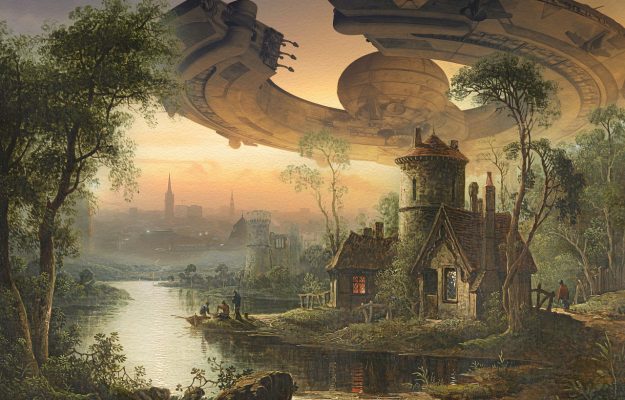



The Martian Chronicles

by Ray Bradbury

Reviewed by Ted Gioia

Countless 16-year-old boys have certainly been disappointed
by this book over the years.
The Martian Chronicles is not
The War of the Worlds
and certainly not Star Wars. There
are no battles in outer space here. No alien abductions. No
slimy creatures with six tentacles and three eyes. Almost all
of the “action” takes place at the emotional and psychological
level—the drama inside the drama so to speak.

In fact, Mars is almost inconsequential in the tales that
comprise Ray Bradbury’s
Chronicles. With a few minor
modifications, many of them could be set on Earth with little
loss in their overall impact. The author has credited
Sherwood Anderson’s
Winesburg, Ohio (1919) as a source of
inspiration for this book, and one couldn’t blame readers
today for concluding that Ray Bradbury’s Mars is very much
like the American Midwest of the first half of the 20th
Century.

In “The Wilderness,” a 1952 story that
Bradbury added to the book in 1974—
he has tinkered with
The Martian
Chronicles
quite a bit over the years—
the plot unfolds in Independence,
Missouri, and focuses on a woman’s
nostalgic journey around her home
town as she prepares to leave on a
space flight to meet her future husband
on Mars. Much the same story could
be constructed about a couple during
the time of the Pilgrims or the California Gold Rush, or even
the Trojan War for that matter; and the details that “date” the
tale are Midwestern, not sci-fi, in nature. Bradbury grafts an
interplanetary angle on to his account, but it adds little to this
sweet, wistful miniature. “Usher II,” a tale about a book lover
devoted to Edgar Allan Poe who wants to get some revenge
against literary censors, is very much in the spirit of
Bradbury’s
Fahrenheit 451, but the elements of the plot that
tie it to Mars are (once again) superficial at best.

I find it amusing that the author changed the dates on his
stories—advancing them forward by 30 years—for a revised
edition of his book. This Mars is no more “realistic” from a
scientific or technological perspective, whether the story is
set in 1997 or 2037 or 2525. Bradbury’s Mars reflects the
world he was dealing with in the 1940s when he wrote these
stories, and only becomes more incongruous the more we
push it out into the future. The “futuristic” technology adds
to the charm of these stories, rather than to their
verisimilitude.

Yet if I dismiss the “scientific” angles here, I only do so to put
greater emphasis on the more compelling aspects of Bradbury’
s book. Jorge Luis Borges wrote the introduction to the 1954
Spanish translation of this book,
Cronicas Marcianas, and
called attention to the sense of “horror and loneliness” that
pervades the work. Instead of the fixation on technology that
Bradbury’s peers brought to their writing, this author is
interested in how technology isolates and haunts the people
who use it. There is truly a
ghost in the machine here,
although perhaps not the one philosopher Gilbert Ryle's
intended when he first employed the phrase. Bradbury's skill
at conveying this type of "spooky loneliness" is unsurpassed
in the field of genre fiction, and only a handful of sci-fi books
(for example, Stanislaw Lem’s
Solaris and Ursula K. Le Guin’s
The Left Hand of Darkness) come close to Bradbury’s work in
this regard.

His astronauts are more alienated than triumphant—all the
more striking given the heroic terms in which space explorers
are typically conceived in stories of this period. In “—And the
Moon Be Still as Bright” and “The Settlers” we encounter the
renegade Spender, who leaves the rest of the crew of the
Martian expeditionary force behind in disgust at their crass
disrespect for the new planet. He later returns to kill his
crewmates, one by one. And his Captain, who should be brutal
in retaliating, finds that he too shares this tragic sense of
being an intruder in a pristine world 50 million miles from
home.

Two of the most powerful stories in
The Martian Chronicles
focus on mourning for dead family members, poignant tales
with little in common with typical pulp fiction fare. In the
story “The Martian,” we meet a couple who have relocated to
the Red Planet, but still lament the loss of their son who died
on Earth years ago. When a strange creature arrives at their
door and artfully imitates the dead youngster Tom, they find
themselves hopelessly attracted to the illusion and the solace
it brings. In another story, a settler isolated on Mars
constructs realistic automatons that play the part of his dead
family. Even when aliens or technology intervene, Bradbury
always searches out the human angle, running counter to
every expectation of the sci-fi genre.

Yes, action and warfare figure occasionally in the plot. But
Bradbury—in a strange quirk that recurs in his writing—
prefers to view them from very, very far away. Nuclear war
devastates the planet Earth in the story “The Off Season,” but
the author presents it from the perspective of a hot dog stand
operator on Mars, who is so distant from the events that he
can hardly comprehend their significance. Another similar
story looks at atomic annihilation from the standpoint of a
luggage retailer on Mars, who is similarly removed from the
heart of the action. At one point in
The Martian Chronicles,
an epidemic wipes out most of the indigenous Martian
population, yet Bradbury deals with this in passing, tossing
off in a few paragraphs what, in the hands of other authors,
would serve as a pivotal moment in the narrative.

Unlike an Isaac Asimov, who could wrap his mind around
centuries and galaxies, Bradbury prefers to view his tragedies
on the intimate level of a person or family, or perhaps a
community. His main topic in
The Martian Chronicles is
ostensibly two entire worlds coming to grips with each other,
but his sensibility constantly draws him to smaller scale
situations. This is his characteristic strength, and the reason
why our author achieved a level of respectability in highbrow
literary circles that no other genre writer of his generation
could match. As he demonstrates again and again in The
Martian Chronicles, Bradbury did not need to dazzle us with
science in order to make his mark as a storyteller. He could
have kept all the rockets back on the earth, and still earned a
stack of awards. Few sixteen-year-olds will appreciate the
subtleties of this book, but when they grow up, the more
perspicacious among them may find that The Martian
Chronicles is a winner even without the special effects.
conceptual
fiction
Back to the home page
Check out our sister sites:

Jazz.com
The New Canon
Great Books Guide
Conceptual Fiction:
A Reading List
(with links to reviews)

Home Page

Abbott, Edwin A.
Flatland

Asimov, Isaac
The Foundation Trilogy

Asimov, Isaac
I, Robot

Atwood, Margaret
The Handmaid's Tale

Banks, Iain M.
The State of the Art

Ballard, J.G.
Crash

Ballard, J.G.
The Crystal World

Bradbury, Ray
Fahrenheit 451

Bradbury, Ray
The Illustrated Man

Bradbury, Ray
The Martian Chronicles

Bradbury, Ray
Something Wicked This Way
Comes

Burgess, Anthony
A Clockwork Orange

Chabon, Michael
The Yiddish Policemen's Union

Clarke, Arthur C.
Childhood's End

Clarke, Arthur C.
A Fall of Moondust

Clarke, Arthur C.
2001: A Space Odyssey

Danielewski, Mark Z.
House of Leaves

Dick, Philip K.
Flow My Tears, the Policeman Said

Dick, Philip K.
The Man in the High Castle

Dick, Philip K.
Ubik

Gaiman, Neil
American Gods

Gibson, William
Burning Chrome

Gibson, William
Neuromancer

Haldeman, Joe
The Forever War

Hall, Steven
The Raw Shark Texts

Heinlein, Robert
The Moon is a Harsh Mistress

Heinlein, Robert:
Stranger in a Strange Land

Heinlein, Robert
Time Enough for Love

Herbert, Frank
Dune

Huxley, Aldous
Brave New World

Le Guin, Ursula K.
The Lathe of Heaven

Le Guin, Ursula K.
The Left Hand of Darkness

Leiber, Fritz
Conjure Wife

Lem, Stanislaw
His Master's Voice

Lem, Stanislaw
Solaris

Lethem, Jonathan
The Fortress of Solitude

Lewis, C. S.
The Chronicles of Narnia

Márquez, Gabriel García
100 Years of Solitude

McCarthy, Cormac
The Road

Miller, Jr., Walter M.
A Canticle for Leibowitz

Mitchell, David
Cloud Atlas

Niffenegger, Audrey
The Time Traveler's Wife

Niven, Larry
Ringworld

Noon, Jeff
Vurt

Okri, Ben
The Famished Road

Pohl, Frederik
Gateway

Rowling, J.K.
Harry Potter & the Sorcerer's
Stone

Saramago, José
Blindness

Silverberg, Robert
Dying  Inside

Silverberg, Robert
Nightwings

Simak, Clifford
City

Simak, Clifford
The Trouble with Tycho

Sturgeon, Theodore
More Than Human

Sturgeon, Theodore
Some of Your Blood

Verne, Jules:
Around the Moon

Verne, Jules:
From the Earth to the Moon

Verne, Jules:
Journey to the Center of the Earth

Wallace, David Foster
Infinite Jest

Wells, H.G.
The First Men in the Moon

Wells, H.G.
The Island of Dr. Moreau

Wells, H.G.
The Time Machine

Zelazny, Roger
Lord of Light


Special Features
Notes on Conceptual Fiction
Curse You, Neil Armstrong!


Links to related sites
The New Canon
Great Books Guide
Ted Gioia's personal web site
SF Site
Jospeh Peschel
The Misread City


Disclosure:  Conceptual Fiction and
its sister sites may receive review
copies and promotional materials
from publishers, authors,  
publicists or other parties.