



conceptual fiction
A Fall of Moondust

By Arthur C. Clarke

Reviewed by Ted Gioia

Who cares about the plot? Obviously not many people
in academia . . . I still recall a college professor making
fun of me when I complained that our class’s assigned
edition of Stendhal contained a plot spoiler on the
back cover. “You shouldn’t be so concerned with the
plot,” Professor Robinson admonished me.

Decades later, I still care about
the plot. Literary critics, for
their part, usually align them-
selves with my old professor.
They rarely acknowledge how
important plot construction is
to the success of a novel, and
focus on other “more important”
matters. Writers who work in
genre fiction, in contrast, have
few illusions that they can save
a weak plot through character
development or symbolism or
some other method of compensation. Henry James
famously spoke of the “turn of the screw”—the added
plot twist that can raise the level of a story—but on any
short list of the masters in the art of turbo-charging a
storyline, even the great James might need to move
aside to make room for popular writers such as Agatha
Christie, P. G. Wodehouse and Arthur C. Clarke.

The classic Clarke books—
Childhood’s End, 2001: A
Space Odyssey
, Rendezvous with Rama—draw
readers into their orbit with plots that are constructed
like multistage rockets (if I may be allowed to use
simultaneously a sci-fi simile and a sci-fi metaphor).
Complexities in the plot are often resolved in his
books, only to replaced by a higher level of
complication. The key moments that might seem to
conclude matters typically prove to be fake-outs,
revealing that the real threat is coming from a
completely different direction than the one we first
anticipated. Of course, Clarke developed his craft in a
pulp fiction environment that demanded clever
plotting; yet even by these standards, he stands out for
his smart incorporation of second-order and third-
order effects in his stories.

Although Arthur C. Clarke’s
A Fall of Moondust was
nominated for the Hugo Award in 1963 (losing out to
Philip K. Dick’s
The Man in the High Castle), and was
the first science fiction book to be featured by
Reader's Digest in their “condensed novels” series, it is
not one of this author’s most widely ready books.  Yet
Clarke’s lunar disaster story ranks among his tightest
and most smartly constructed novels. Here he displays
his knack for adding a new “turn of the screw” every
few chapters, so that the crisis scenario he is unfolding
gets deeper and deeper—both literally and
metaphorically.

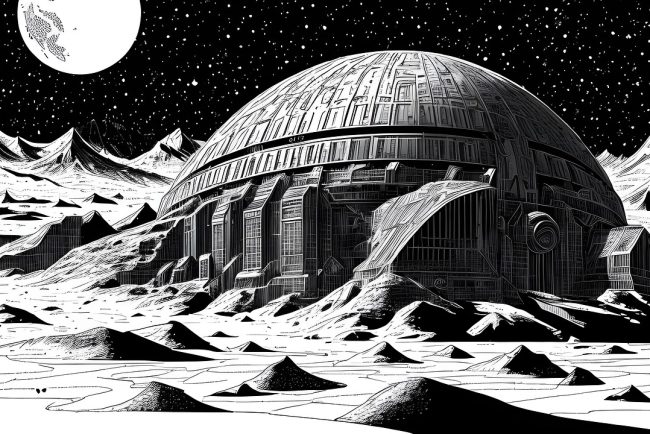
For his main characters are caught in a sea of dust
when their lunar tourist expedition gets caught up in
“dry tsunami.” Their vehicle—a cross between a bus
and a boat—is trapped below the surface, and rescue
efforts can find no visible trace of where or how they
disappeared. Imagine a story that combines the most
distressful elements of a “lost at sea” tale, a “mining
disaster” story, and a “astronaut running out of
oxygen” adventure, and you will get some idea of the
scenario Clarke has contrived.

Clarke is usually at his weakest when it comes to
developing characters. He is better at creating
scenarios than protagonists, and usually the plot
drives the characters in his books, rather than the
other way around. But in
A Fall of Moondust, he needs
to build dramatic scenes from the interactions of the
trapped crew and passengers, and the result is a
storyline that is far more personality-driven than one
typically finds with this author. His eccentric and
contentious characters create a tableau that is more
like
Murder on the Orient Express than 2001: A Space
Odyssey
.

The occupants of the Selene, his "lost at sea" tourist
craft, include a retired space travel hero, an Australian
aboriginal physicist, a crank who is obsessed with
UFOs, a lawyer and his wife, a retired “dancer,” and
other lively characters. They are not handled in a
completely realistic manner—but, for that matter,
neither are the figures in Dickens or Proust—but
Clarke does show how he can create drama, tension
and humor in set pieces that are not much different
from the scenes other authors place in drawing rooms
and hunting lodges.

As usual, Clarke weaves a lot of science around his
account, even more here than is typically the case in
his novels. I am still amazed by how many surprises
and new scientific angles he can extract from dust. He
works every possible trick you can imagine from this
mundane starting-point—almost as if
Iron Chef had
baking soda as the main ingredient in one of their
competitions. In a genre that typically reaches for
larger than life effects, Clarke pulls off the old
switcheroo and goes small for a change. Very small.

He also extracts some fine landscape writing from the
dust. “The boat’s wake became longer and more
disturbed as the spinning fans bit fiercely in the dust.
Now the dust itself was being tossed up on either side
in great ghostly plumes; from a distance, Selene would
have looked like a snowplough driving its way across a
winter landscape, beneath a frosty moon. . . . When
Harris swung Selene into a tight turn, so that she
orbited in a circle, the boat almost overtook the falling
veils of powder her fans had hurled into the sky. It
seemed altogether wrong that this impalpable dust
should rise and fall in such clean-cut curves, utterly
unaffected by air resistance . . . .”

And this passage (from page ten) is just the start of
Clarke’s love-hate relationship with dust,
demonstrated at length in this work. Give that man a
Swiffer mop and a space suit! And where does it all
end? I would love to fill you in on all the details, but I
still hate plot spoilers.  Sorry, Professor Robinson!
Back to the home page
Follow Ted Gioia on Twitter at
www.twitter.com/tedgioia


Conceptual Fiction:
A Reading List
(with links to reviews)

Home Page

Abbott, Edwin A.
Flatland

Adams, Douglas
The Hitchhiker's Guide to the
Galaxy

Amis, Martin
Time's Arrow

Asimov, Isaac
The Foundation Trilogy

Asimov, Isaac
I, Robot

Atwood, Margaret
The Handmaid's Tale

Banks, Iain M.
The State of the Art

Ballard, J.G.
Crash

Ballard, J.G.
The Crystal World

Bester, Alfred
The Demolished Man

Bradbury, Ray
Dandelion Wine

Bradbury, Ray
Fahrenheit 451

Bradbury, Ray
The Illustrated Man

Bradbury, Ray
The Martian Chronicles

Bradbury, Ray
Something Wicked This Way
Comes

Burgess, Anthony
A Clockwork Orange

Card, Orson Scott
Ender's Game

Chabon, Michael
The Yiddish Policemen's Union

Chiang, Ted
Stories of Your Life and Others

Clarke, Arthur C.
Childhood's End

Clarke, Arthur C.
A Fall of Moondust

Clarke, Arthur C.
2001: A Space Odyssey

Clarke, Susanna
Jonathan Strange & Mr Norrell

Danielewski, Mark Z.
House of Leaves

Dick, Philip K.
Flow My Tears, the Policeman
Said

Dick, Philip K.
The Man in the High Castle

Dick, Philip K.
Ubik

Doctorow, Cory
Down and Out in the Magic
Kingdom

Gaiman, Neil
American Gods

Gibson, William
Burning Chrome

Gibson, William
Neuromancer

Haldeman, Joe
The Forever War

Hall, Steven
The Raw Shark Texts

Harrison, M. John
Light

Heinlein, Robert
The Moon is a Harsh Mistress

Heinlein, Robert:
Stranger in a Strange Land

Heinlein, Robert
Time Enough for Love

Herbert, Frank
Dune

Huxley, Aldous
Brave New World

Le Guin, Ursula K.
The Lathe of Heaven

Le Guin, Ursula K.
The Left Hand of Darkness

Leiber, Fritz
The Big Time

Leiber, Fritz
Conjure Wife

Leiber, Fritz
Swords & Deviltry

Leiber, Fritz
The Wanderer

Lem, Stanislaw
His Master's Voice

Lem, Stanislaw
Solaris

Lethem, Jonathan
The Fortress of Solitude

Lewis, C. S.
The Chronicles of Narnia

Márquez, Gabriel García
100 Years of Solitude

McCarthy, Cormac
The Road

Miéville, China
Perdido Street Station

Miller, Jr., Walter M.
A Canticle for Leibowitz

Mitchell, David
Cloud Atlas

Niffenegger, Audrey
The Time Traveler's Wife

Niven, Larry
Ringworld

Noon, Jeff
Vurt

Okri, Ben
The Famished Road

Pohl, Frederik
Gateway

Pynchon, Thomas
Gravity's Rainbow

Robinson, Kim Stanley
Red Mars

Rowling, J.K.
Harry Potter & the Sorcerer's
Stone

Saramago, José
Blindness

Shelley, Mary
Frankenstein

Silverberg, Robert
Dying  Inside

Silverberg, Robert
Nightwings

Simak, Clifford
City

Simak, Clifford
The Trouble with Tycho

Smith, Cordwainer
Norstrilia

Smith, Cordwainer
The Rediscovery of Man

Stephenson, Neal
Snow Crash

Stross, Charles
Glasshouse

Sturgeon, Theodore
More Than Human

Sturgeon, Theodore
Some of Your Blood

Van Vogt, A.E.
The World of Null A

Verne, Jules:
Around the Moon

Verne, Jules:
From the Earth to the Moon

Verne, Jules:
Journey to the Center of the
Earth

Wallace, David Foster
Infinite Jest

Wells, H.G.
The First Men in the Moon

Wells, H.G.
The Island of Dr. Moreau

Wells, H.G.
The Time Machine

Zelazny, Roger
Lord of Light


Special Features
Notes on Conceptual Fiction
Ray Bradbury: A Tribute
Remembering Fritz Leiber
Curse You, Neil Armstrong!
Robert Heinlein at 100


Links to related sites
The New Canon
Great Books Guide
Postmodern Mystery
Ted Gioia's web site


SF Site
io9
Graeme's Fantasy Book Review
Los Angeles Review of Books
Jospeh Peschel
The Misread City
Reviews and Responses
SF Signal
True Science Fiction


Disclosure:  Conceptual Fiction
and its sister sites may receive
review copies and promotional
materials from publishers,
authors,  publicists or other
parties.