
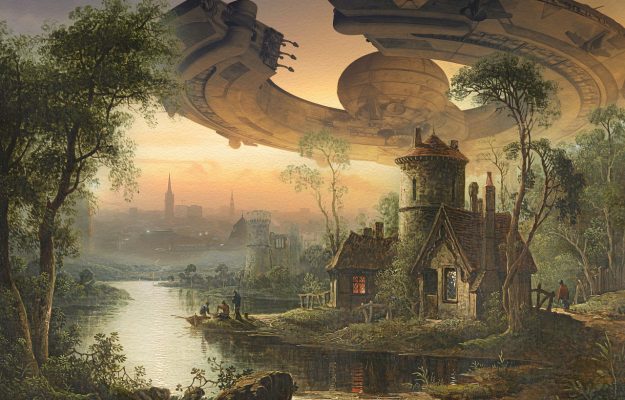



Something Wicked This Way Comes
By Ray Bradbury
Reviewed by Ted Gioia
Ray Bradbury will forever be remembered as a writer of
genre stories, yet most of his oeuvre reveals a stubborn
resistance—that borders on obliviousness—to the accepted
formulas of the pulp fiction trade. He has complained about
the sci-fi label invariably applied to his work—“I've only done
one science fiction book and that's Fahrenheit 451, based on
reality,” is his oft-quoted comeback. And his best known
outer space work, The Martian Chronicles, has about as much
about the Red Planet as a Mars chocolate
bar. In general, the science in his various
tales is rarely more than a passing fancy,
and sometimes totally absent.
And then we come to his "horror" novel,
Something Wicked This Way Comes. How
does Bradbury fare when dealing with a
terror-inducing tale of the supernatural?
An early warning sign that this book is not
your typical scary story arrives even before
the opening sentence. The dedication to silver
screen idol Gene Kelly will come as a surprise
to many readers—even more so, when they
learn that Bradbury originally conceived this
story as a film feature for the charming song-and-
dance man to produce. Even more to the point,
I can easily imagine Mr. Kelly residing in the slice-of-Americana,
Norman Rockwell-ish setting (based on Bradbury’s home town of
Waukegan, Illinois) where the novel takes place. No, Nightmare on
Elm Street this is not.
Certainly Bradbury tries to amplify the horror as best he can, which
revolves around a sinister carnival coming to town, but his
temperament is not suited for dark themes. The supposedly spine-
tingling scenes are among the most perfunctory in the book.
Meanwhile the author really hits his stride when waxing nostalgically
over issues of youth and aging, life in Middle America, and other
familiar Bradbury themes. Two-thirds of the way through the novel,
the reader is rewarded with a long monologue on the metaphysics of
good and evil, delivered by a janitor at the local library, and this
interlude is thought-provoking and powerful, but has taken us so far
away from the conventions of the horror story, that we wonder
whether Bradbury will ever find his way back.
Here is a dose of this speech:
First things first. Let’s bone up on history. If men had wanted to stay
bad forever they could have, agreed?...Somewhere we turned in our
carnivore’s teeth and started chewing blades of grass. We been
working mulch as much as blood, into our philosophy, for a quite a
few lifetimes. Since then we measure ourselves up the scale from
apes, but not half so high as angels…. I suppose one night hundreds of
thousands of years ago in a cave by a night fire when one of those
shaggy men wakened to gaze over the banked coals at his woman, his
children, and thought of their being cold, dead, gone forever. Then he
must have wept. And he put out his hand in the night to the woman
who must die some day and to the children who must follow her. And
for a little bit next morning, he treated them somewhat better, for he
saw that they, like himself, had the seed of night in them….
This goes on, with a few interjections from the youngsters in
attendance on the Socratic exercise, for more than ten pages. The
reader can sense Bradbury’s excitement, and even get a feeling that
this is the core of the novel from the author’s perspective. What a
contrast from horror story maestro H.P. Lovecraft, a key role model
for Bradbury in a book of this sort, or from Stephen King, who was
inspired in turn by this novel, but would never let his appreciation of
metaphysics get in the way of the plot.
The plot, in Bradbury’s case builds on the exploits two thirteen-year-
old boys, Will Halloway and Jim Nightshade, who find themselves
irresistibly drawn to the strange carnival that has arrived in town—
even as they grow fearful in the face of the mysterious goings-on and
odd characters they encounter. One of the proprietors of the traveling
show, Mr. Dark, makes them shudder with his torso and limbs covered
with tattoos. He is sometimes called the Illustrated Man here, and thus
stands as another example of Bradbury’s willingness to recycle
concepts and character types, and sometimes entire stories, from his
earlier books. But our young heroes also cross paths with the Dust
Witch, the Skeleton, the Dwarf and Mister Electrico, among other
unsavory carnival characters.
Bradbury tosses in some evil apparatuses for good measure. We have
a carousel that can make the rider turn older and younger, depending
on whether it is running forward or reverse. A house of mirrors
beckons people into a frightening labyrinth, where the reflected images
seem to turn on the unwary originals. We have an electric chair, a
predatory hot air balloon, and a guillotine and other instruments of
horror. Bradbury is especially skilled at employing these elements as
objective correlatives in creating an atmosphere of dread and suspense.
Yet, above all, this is a beautifully written book, perhaps the most
poetic horror novel of its time. Not a single page comes across as
perfunctory, and even when the plot is moving at its fastest pace, the
author measures every phrase, and luxuriates in his imagery and
asides. In fact, Bradbury runs the risk of undercutting the scary
elements, by presenting them in such majestic sentences. In the final
analysis, he transforms this novel into a coming-of-age story, in which
the darker elements are again and again pushed to the periphery. Yes,
you will find more terrifying tales than Something Wicked This Way
Comes, but few that turn the ingredients of the horror genre into
something quite so exquisite.
Click on image to purchase
Follow Ted Gioia on Twitter at
www.twitter.com/tedgioia
Conceptual Fiction:
A Reading List
(with links to reviews)
Home Page
Abbott, Edwin A.
Flatland
Adams, Douglas
The Hitchhiker's Guide to the Galaxy
Allende, Isabel
The House of the Spirits
Amis, Martin
Time's Arrow
Apuleius
The Golden Ass
Asimov, Isaac
The Foundation Trilogy
Asimov, Isaac
I, Robot
Atwood, Margaret
The Handmaid's Tale
Banks, Iain M.
The State of the Art
Ballard, J.G.
Crash
Ballard, J.G.
The Crystal World
Bester, Alfred
The Demolished Man
Bradbury, Ray
Dandelion Wine
Bradbury, Ray
Fahrenheit 451
Bradbury, Ray
The Illustrated Man
Bradbury, Ray
The Martian Chronicles
Bradbury, Ray
Something Wicked This Way Comes
Bulgakov, Mikhail
The Master and Margarita
Burgess, Anthony
A Clockwork Orange
Card, Orson Scott
Ender's Game
Chabon, Michael
The Yiddish Policemen's Union
Chiang, Ted
Stories of Your Life and Others
Clarke, Arthur C.
Childhood's End
Clarke, Arthur C.
A Fall of Moondust
Clarke, Arthur C.
2001: A Space Odyssey
Clarke, Susanna
Jonathan Strange & Mr Norrell
Crowley, John
Little, Big
Danielewski, Mark Z.
House of Leaves
Delany, Samuel R.
Babel-17
Delany, Samuel R.
Dhalgren
Delany, Samuel R.
The Einstein Intersection
Dick, Philip K.
Flow My Tears, the Policeman Said
Dick, Philip K.
The Man in the High Castle
Dick, Philip K.
Ubik
Doctorow, Cory
Down and Out in the Magic Kingdom
Esquivel, Laura
Like Water for Chocolate
Fuentes, Carlos
Aura
Gaiman, Neil
American Gods
Gibson, William
Burning Chrome
Gibson, William
Neuromancer
Grass, Günter
The Tin Drum
Haldeman, Joe
The Forever War
Hall, Steven
The Raw Shark Texts
Harrison, M. John
Light
Heinlein, Robert
The Moon is a Harsh Mistress
Heinlein, Robert:
Stranger in a Strange Land
Heinlein, Robert
Time Enough for Love
Helprin, Mark
Winter's Tale
Herbert, Frank
Dune
Huxley, Aldous
Brave New World
Kundera, Milan
The Book of Laughter and Forgetting
Le Guin, Ursula K.
The Lathe of Heaven
Le Guin, Ursula K.
The Left Hand of Darkness
Leiber, Fritz
The Big Time
Leiber, Fritz
Conjure Wife
Leiber, Fritz
Swords & Deviltry
Leiber, Fritz
The Wanderer
Lem, Stanislaw
His Master's Voice
Lem, Stanislaw
Solaris
Lethem, Jonathan
The Fortress of Solitude
Lewis, C. S.
The Chronicles of Narnia
Link, Kelly
Magic for Beginners
Mann, Thomas
Doctor Faustus
Márquez, Gabriel García
100 Years of Solitude
McCarthy, Cormac
The Road
Miéville, China
Perdido Street Station
Miller, Jr., Walter M.
A Canticle for Leibowitz
Millhauser, Steven
Dangerous Laughter
Mitchell, David
Cloud Atlas
Murakami, Haruki
1Q84
Niffenegger, Audrey
The Time Traveler's Wife
Niven, Larry
Ringworld
Noon, Jeff
Vurt
Obreht, Téa
The Tiger's Wife
Okri, Ben
The Famished Road
Pohl, Frederik
Gateway
Pynchon, Thomas
Gravity's Rainbow
Rabelais, François
Gargantua and Pantagruel
Robinson, Kim Stanley
Red Mars
Rowling, J.K.
Harry Potter & the Sorcerer's Stone
Rushdie, Salman
Midnight's Children
Saramago, José
Blindness
Shelley, Mary
Frankenstein
Silverberg, Robert
Dying Inside
Silverberg, Robert
Nightwings
Simak, Clifford
City
Simak, Clifford
The Trouble with Tycho
Smith, Cordwainer
Norstrilia
Smith, Cordwainer
The Rediscovery of Man
Stephenson, Neal
Snow Crash
Stross, Charles
Glasshouse
Sturgeon, Theodore
More Than Human
Sturgeon, Theodore
Some of Your Blood
Tolkien, J.R.R.
The Hobbit
Updike, John
The Witches of Eastwick
Van Vogt, A.E.
The Mixed Men
Van Vogt, A.E.
Slan
Van Vogt, A.E.
The Voyage of the Space Beagle
Van Vogt, A.E.
The World of Null A
Verne, Jules
Around the Moon
Verne, Jules
From the Earth to the Moon
Verne, Jules:
Journey to the Center of the Earth
Vonnegut, Kurt
Cat's Cradle
Vonnegut, Kurt
The Sirens of Titan
Vonnegut, Kurt
Slaughterhouse-Five
Wallace, David Foster
Infinite Jest
Wells, H.G.
The First Men in the Moon
Wells, H.G.
The Island of Dr. Moreau
Wells, H.G.
The Time Machine
Woolf, Virginia
Orlando
Zelazny, Roger
Lord of Light
Special Features
Notes on Conceptual Fiction
Ray Bradbury: A Tribute
The Year of Magical Reading
Remembering Fritz Leiber
Samuel Delany's 70th birthday
The Sci-Fi of Kurt Vonnegut
Curse You, Neil Armstrong!
Robert Heinlein at 100
A.E, van Vogt Tribute
Links to related sites
The New Canon
Great Books Guide
Postmodern Mystery
Ted Gioia's web site
SF Site
io9
Graeme's Fantasy Book Review
Los Angeles Review of Books
Big Dumb Object
Jospeh Peschel
The Misread City
Reviews and Responses
SF Signal
True Science Fiction
Disclosure: Conceptual Fiction
and its sister sites may receive
review copies and promotional
materials from publishers,
authors, publicists or other
parties.